
Amherst City Directory Shelves
Amherst city directories survive through several repositories, rather than one uninterrupted run. The Amherst Historical Society identifies a practical group of scans from 1889 through 1923. Massachusetts Historical Commission building forms cite a broader 1869 through 1975 run at Jones Library Special Collections and through Ancestry. The Massachusetts State Library lists selected volumes, and its notation adds an important distinction: an asterisk identifies a volume that contains a house guide. Check the volume itself before treating a listed year as a complete annual sequence or assigning an unverified publisher.
| Collection | Years | Where Held | Access |
|---|---|---|---|
| Historical Society directory links | 1889-1890, 1892-1893, 1895, 1897-1898, 1905-1923 selected volumes | Amherst Historical Society links, many to Archive.org | Online scans where linked |
| MHC-cited Amherst volumes | 1869-1975 broad run | Jones Library Special Collections and Ancestry | Collection and subscription access |
| State Library Amherst holdings | 1901, 1905-1906, 1912-1914, 1916-1917, 1919, 1923, and selected later years to 1951 | Massachusetts State Library | Holdings list; asterisk means house guide |
| Ancestry U.S. historical volumes | Located Amherst entries from 1873 through 1936, plus a broader run cited to 1975 | Ancestry, including possible library edition access | Subscription or participating-library access |
| Library of Congress directory collection | Primarily 1861-1960, availability varies by city | LOC print, microfilm, and electronic inventory | Check the Amherst inventory before requesting |
There are real gaps in the evidence. The Historical Society list is not a promise that every intervening Amherst year exists, and the State Library list marks only selected holdings. A missing name can reflect a missing volume, a different spelling, a shared Amherst-Hadley-Hatfield heading, or the limits of the book, not a confirmed departure.
Amherst City Directories Online
The quickest digitized starting point is the Amherst Historical Society resource list, which links the historic directory volumes and related Amherst history. Its list supports the 1889 through 1923 group, but title pages should be read before recording a printer or publisher. Ancestry supplies another searchable channel with fields for names, residence year and place, spouse, keyword, and publication title. The original image and title-page information remain the controlling evidence when a database transcription differs.
The Massachusetts State Library holdings list adds selected Amherst years, including volumes marked as house guides. The Library of Congress directory guide is useful for locating city, street-address, telephone, and criss-cross material, although Amherst availability must be checked city by city. A reverse or criss-cross volume is an address-keyed layer, not something to assume every regular directory contains.
Amherst City Directory Access
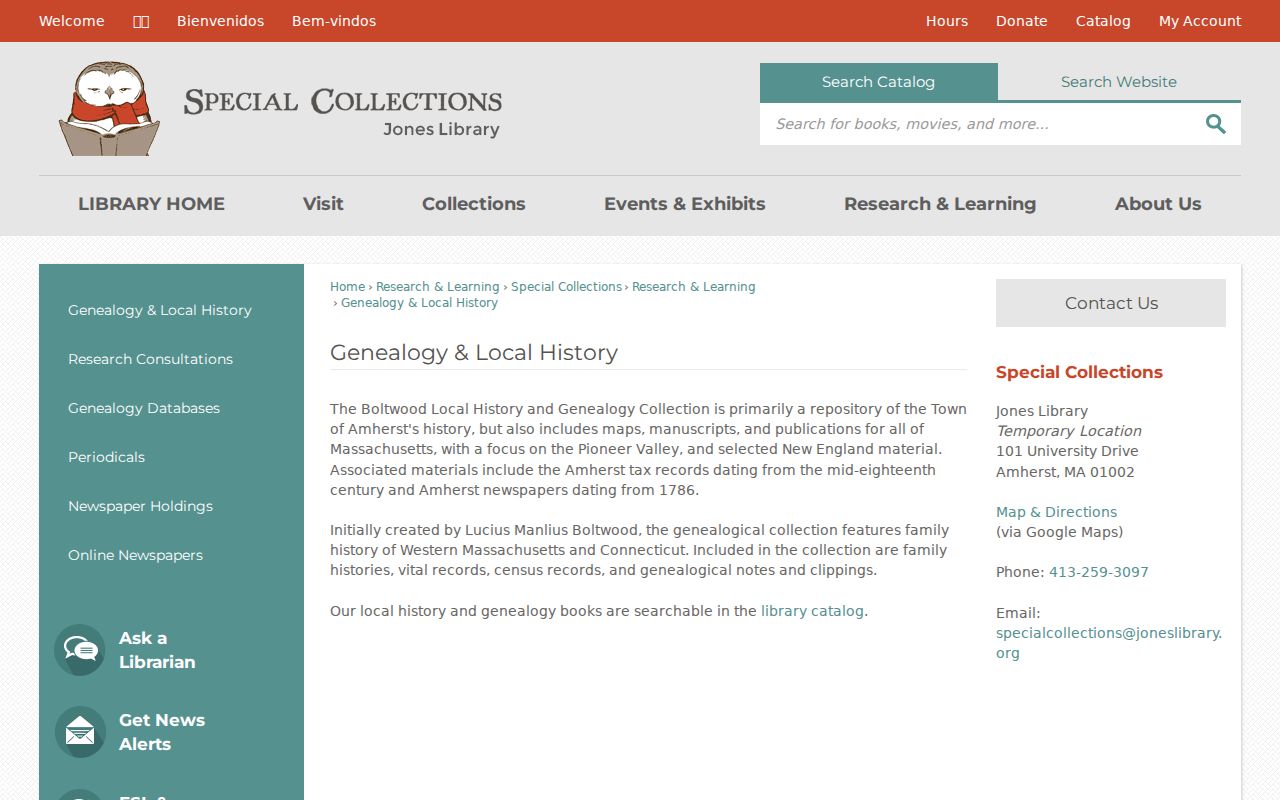
Jones Library is the local fallback when a scan is missing, an index cannot resolve an initial, or a companion source is needed. The Boltwood Local History and Genealogy Collection holds Amherst tax records from the mid-eighteenth century, newspapers from 1786, family histories, vital and census material, maps, manuscripts, and clippings. Local-history books are searchable through the library catalog. Those holdings make it possible to test a directory line against material that records an event or a property more closely.
The Jones Library Genealogy and Local History page describes the Boltwood collection and its broader Amherst record trail.
Use the collection as a verification shelf for a city directory finding, especially when an older name, a newspaper notice, or a tax clue needs context beyond a single listing.
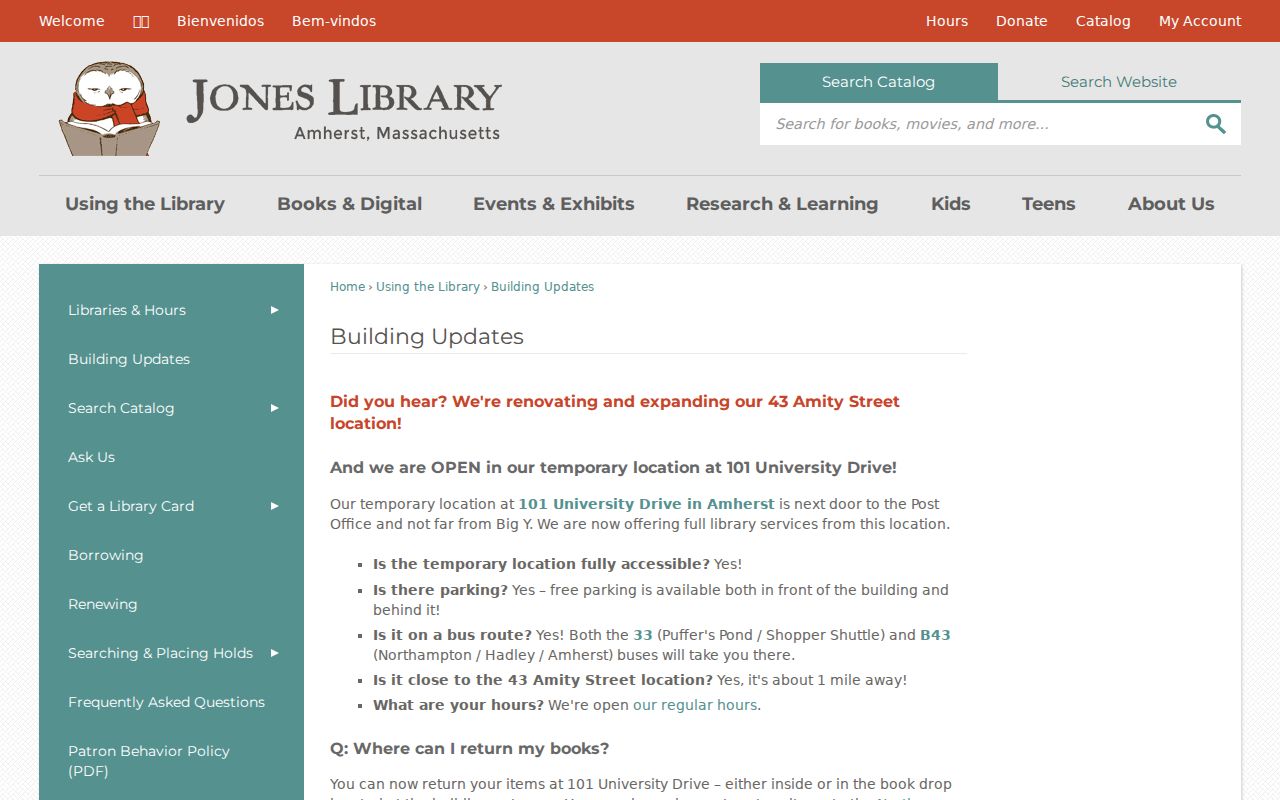
Access has changed during the renovation. The main library is temporarily at 101 University Drive in Amherst, and Special Collections is available by appointment. The former 43 Amity Street building closed in May 2025 for renovation and expansion; the library estimates a return in 2027. Special Collections can be reached at 413-259-3097 or specialcollections@joneslibrary.org before an in-person visit.
The Jones Library building-updates page confirms the temporary location and appointment status.
Calling ahead protects a directory research trip from ending at the former downtown building or arriving when Special Collections access is not available.
Reading Amherst Directory Entries
An Amherst directory entry is an historical snapshot, not a modern identity record. Start with the alphabetical heading and preserve spelling, initials, punctuation, and every notation exactly as printed. The content can include a residence address, occupation or affiliation, a spouse or widow marker, an institutional or business entry, and later a telephone number or exchange. Rural listings may use a road or village name. A college or institutional listing needs special care because it may not describe a permanent Amherst household.
| Name heading | Surname followed by given name or initial, copied exactly for later comparisons. |
|---|---|
| Residence | Street and number when supplied; some entries use a road, village, or other local description. |
| Occupation or affiliation | Historical context only, not proof of a person’s present identity. |
| Relationship marker | Spouse, widow, or other household notation when the volume supplies it. |
| Institution or business entry | Separate listings may name colleges, churches, schools, shops, or local societies. |
| House-guide possibility | Check whether the volume is marked with an asterisk in the State Library list and inspect the address section. |
| Telephone information | Later volumes may include a number or exchange; its presence is volume-specific. |
Do not expand shorthand from memory. The front matter is the source for every abbreviation and relationship key.
- Criss-cross directory
- An address-keyed directory layer that can lead from a street address to an occupant. Amherst holdings for a particular year must be confirmed before relying on it.
- House guide
- An address or street section within a directory. The State Library’s Amherst asterisk means the listed volume contains one.
- Householder index
- A name arrangement centered on a household entry where a volume uses that form. Compare it with the street section rather than assuming both are complete.
- Abbreviation key
- The volume’s front-matter guide for symbols such as “h,” “r,” and “wid.” Copy the key with the entry because meanings can vary.
Amherst House Guides and Criss-Cross
Address research works differently from a name search. The State Library identifies house-guide content in selected Amherst years, including 1927-1928, 1930, 1932-1933, 1938, 1940, 1942, 1948, 1950, and 1951. That mark means a reader can look for a street-oriented section in that particular volume. It does not establish a house guide in every year, and it does not turn a directory result into proof of ownership or a full household list.
Ask Jones Special Collections and check the Library of Congress inventory when the goal is an address-to-occupant trail. Exact local reverse-directory years were not located in the official Jones description. For present-day address records, the Amherst street directory follows the separate property, map, and deed route rather than repeating the historical shelf.
Amherst’s 1910 Directory Context
Amherst’s directory evidence sits within a larger record history. Amherst separated from Hadley in 1759, gained an Amherst and Belchertown Railroad station in 1853, and grew from agricultural, industrial, college, and campus influences. That history helps explain why names can appear under nearby-community headings or alongside institutions. The town’s three colleges also mean an address or affiliation requires careful interpretation before it is treated as a lasting household connection.
The Library of Congress Amherst Sanborn map is an 18-sheet 1910 set that can test a directory address against a building footprint, construction context, street continuity, or use. It does not name every resident. Pairing the map with a directory provides a useful local story: the directory supplies a name-and-address snapshot while the map supplies the physical setting at a related date.
Note: The record trail has practical gaps, including missing directory years and a January 1954 gap in the Amherst Record, not a documented local records-disaster story.
Trace an Amherst Directory Household
A careful household trace uses available years, not assumed annual coverage. Begin with the exact directory volume closest to a known name or address. Then compare the person, spelling, address, relationship notation, and affiliation with the next available volume. Each difference is a lead to verify, not a conclusion. The federal census provides a second dated snapshot, while tax, deed, permit, newspaper, obituary, probate, cemetery, and Special Collections material can explain a move, death, institution change, or property transfer.
- Choose an available Amherst city directory closest to the target year and search the alphabetical section by the full surname and initials.
- Transcribe the address, occupation or affiliation, spouse or relationship marker, and every abbreviation before moving to another source.
- Check the house-guide or street section when the selected volume contains one, then compare nearby volumes and relevant combined Amherst-Hadley-Hatfield headings.
- Repeat at five-year or other available intervals. Mark a missing volume or missing name as a gap instead of calling it a move or death.
- Pair the result with open federal census years: 1900, 1910, 1920, 1930, 1940, and 1950 are usable under the federal 72-year rule. The 1960 census is not generally open until 2032.
- Use a contemporaneous local record to test the change: assessment and sale history for a parcel, a permit for an alteration, or a newspaper, obituary, or probate record for a departure or estate event.
Federal census dates, directory dates, and local filing dates answer different questions. Census names a household at its census date. A city directory records its own publication-era snapshot. A deed identifies title, a permit dates an improvement, and a newspaper or obituary may illuminate a change without proving continuous residence.
Amherst Directory Dates and Evidence
Directory date should always be recorded with the source title and page. MHC historic-building forms show the practical local method: they pair Amherst city directories with town property cards, census years, obituaries, maps, deeds, and Jones Special Collections correspondence. That combination is stronger than a bare directory line because it separates occupancy clues from title history and from the date work was done on a structure.
The Hampshire Registry records land transfers, but a deed can lack a street address and early property search fields are incomplete. Amherst Maps holds modern parcel and property-card context. Those sources help test a directory address when a legal description, map, parcel split, or changed street name complicates the match. They do not remove the need to preserve uncertainty where the records do not connect cleanly.
Amherst Newspapers Fill Gaps
Jones newspaper holdings provide a strong companion when directories skip a year or a surname disappears. The Hampshire Gazette begins in 1786, while later holdings include the Amherst Record from 1868 to 1984 with a January 1954 gap and the Amherst Bulletin from 1984 to the present on indexed microfilm. Notices, obituaries, public meetings, marriages, and property references can add dated context to the sparse line in a city directory.
Amherst Historical Society resources also link digitized books, local histories, directory scans, street-history material, and historic-building sources. These are useful for family history and historical context, but the original volume, custodian record, or image should be checked before a name, address, or relationship is treated as settled.
Amherst Directory Limits and Gaps
Amherst city directories do not supply a complete resident roll for every year or every household. The publisher line for the full 1869 through 1975 run was not verified in the official source material, so each selected scan needs a title-page check. The Library of Congress cautions that city-directory coverage can have gaps of up to five years. Amherst entries can also overlap nearby communities, while common names require a middle initial, spouse, institution, parcel, or date to avoid a false match.
Special Collections, the Historical Society, the State Library, Ancestry, and the Library of Congress form a useful access chain. Use the online version first where it exists, then ask the local collection about an unscanned volume or companion record. The most reliable result preserves the source, date, page, spelling, and gap instead of forcing a continuous story from uneven historical records.