
Amherst Resident Lookup Records
There is no single official roll of everyone in Amherst. Each record answers a narrower question. The Amherst Property Search identifies an owner and parcel facts, but it does not list every household member and a mailing address is only a tax-contact clue. The state voter tool is a protected individual self-check, while local voter records have different public-record rules. Court, probate, vital, business, and license records add context only when the names, dates, and jurisdictions line up. Treat an apparent match as a lead until two independent facts support it.
| Record | What It Confirms | Where | Access |
|---|---|---|---|
| Property card | Parcel owner, situs and mailing addresses, sale and assessment context | Amherst Property Search | Free public search; not a household list |
| Local voter record | Public registration fields where disclosure is allowed | Amherst Town Clerk | Local request; confidential fields withheld |
| Court docket | Public case participation, events, and disposition | Massachusetts Trial Court Case Access | Online, terminal, and clerk-file routes |
| Vital record | An event filed in the proper community or statewide system | Amherst Vital Records | Copy eligibility and age rules apply |
| License or filing | Professional status or a reported business connection | Massachusetts license search | Free status search; narrow purpose |
Begin with a parcel only when ownership is plausible. Begin with a court name search when a case number, court, or filing period is known. For a past person, a vital event, probate file, cemetery record, or local newspaper notice may distinguish names better than a current record. A license or business filing can confirm a credential or association, but neither establishes where a person lives.
Note: A property card can identify a parcel owner, but it does not identify every resident or person receiving mail there.
Verify an Amherst Resident Name
A same-name result is especially risky around Amherst, Hadley, Belchertown, and Northampton because nearby addresses can share county records and mail routes. Use the exact spelling first, then record variants without treating them as the same person. The strongest trail joins a place and a time to a name. Amherst Maps can supply a parcel ID, owner spelling, and sale date. Those details can be tested against a deed, a public case, or an estate. The property card's mailing address should not be treated as proof that the owner occupies the parcel.
- Write down the full name, middle initial if known, an Amherst street or ZIP, and the approximate year. Keep each fact with its source.
- Search the Amherst property system by owner name, address, or parcel ID. Preserve the distinction between the parcel's situs and the owner mailing address.
- Use the state voter form only for the individual voter’s own registration check. For a lawful request for public local voter fields, ask the Town Clerk for the date, format, and scope needed.
- Run name variants in the civil-name tab at MassCourts, select the court department and location, and compare the case number, party role, filing date, and disposition.
- For a property connection, search the owner as grantor and grantee in the Hampshire Registry, then match the legal description or plan to the parcel rather than relying on a surname.
- Add an event record only through its proper custodian. A marriage, death, cemetery entry, probate filing, or obituary can supply a date or relationship that resolves an otherwise uncertain result.
- If details conflict, stop the match. Ask the clerk, register, Town Clerk, or Assessors office to correct the source record instead of carrying a doubtful identity forward.
The Secretary of the Commonwealth’s voter-information guidance distinguishes public local records from the protected statewide registry.

The statewide form asks for identifying information because it is designed to verify one voter, not to browse a neighborhood or assemble a list of residents.
Amherst Resident Court Search
Massachusetts Trial Court Case Access is the online route for public dockets serving Amherst. Start by choosing Court Department and Court Division, then Court Location when that control appears. The Name tab accepts last and first name, with optional middle name and suffix. It also provides company-name searching, case type, case status, party type, and date ranges. The portal's instructions require at least two characters for a civil-search last name and one for the first name. A result is not an official court record, and it may not include every document.
| MassCourts field | How it helps |
|---|---|
| Court Department and Division | Sets the type of court and opens the related search controls. |
| Court Location | Narrows a department search to a location when available. |
| Name or Company Name | Separates an individual party search from a business case search. |
| Case Status and Party Type | Helps interpret whether a listed person is plaintiff, defendant, trustee, or another party. |
| File-date range | Reduces false matches when an approximate period is known. |
One docket result can show a party name and role, case-number link, court department, division or location, filing date, case type, status, events, and disposition details where public. A case number may appear more than once because a result row represents a party. Read the case detail before drawing conclusions. A docket appearance does not prove wrongdoing, liability, or even that every party with a similar name is the same person.
MassCourts public access displays the state court search interface.
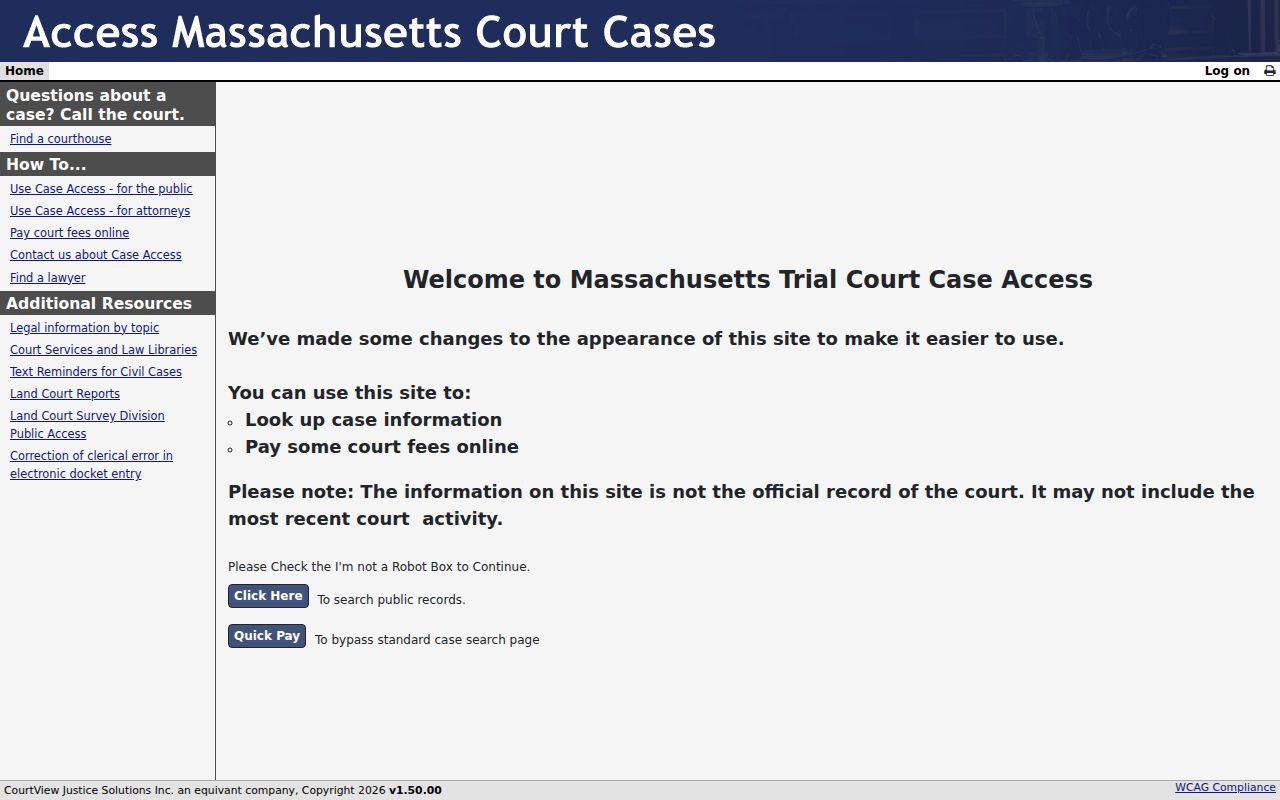
For a document unavailable online, a public terminal at a courthouse or Registry of Deeds site may provide more access. The Clerk, Register, or Recorder keeps the official file and handles certified-copy requests.
- Docket
- A court’s running case record, usually showing filings, events, parties, and results that are public.
- Index
- A searchable list that points to a record. It is useful for finding a case or document, but it is not necessarily the complete file.
- Image
- A scanned view of a document. An image can show details omitted from an index, but access depends on the record and court rule.
- Certified copy
- A copy issued by the custodian with its official certification. Ask the clerk, register, or Town Clerk for the current process and fee.
Note: Read the case detail and verify the party before treating a search result as a record connected to an Amherst resident.
Amherst Voter Self-Check Limits
The Massachusetts voter-status search requires first name, last name, month, day and year of birth, the five-digit residential ZIP, and an acknowledgement. It is expressly for an individual checking that individual’s status. A match is registration evidence for that voter at that time. It is not a public name-and-address directory, a street search, or a ZIP-wide list. The statewide central registry is not public. Those limits matter when a resident lookup produces no result, because a non-match is not evidence that a person never lived in Amherst.
Local voter records are different. The Secretary identifies public local fields that can include name, residential address, party, date of birth, active or inactive status, voter ID number, voting history, registration date, and some address-change information. Phone, email, permanent absentee status, minor preregistration, and confidential-voter information are not ordinary public fields. A request to the Amherst Town Clerk should state the desired date, paper or electronic format, and a precinct or district scope if relevant. The current local fee and form should be confirmed with the office.
Note: A local voter record is a dated registration record, not proof that every person living at an address is a registered voter.
Amherst Vital Record Routing
Amherst Vital Records can issue a local copy only when Amherst is the proper filing community. A birth may be obtained from the community of birth, a parent’s community of residence at birth, or the state Registry of Vital Records and Statistics. A death may be routed through the community of death, the decedent’s residence community, or the state registry. A marriage belongs with the community where notice of intention was filed or the state registry. Divorce records belong with the Trial Court process, not the Town Clerk’s marriage files.
Massachusetts General Laws c. 46 limits access to restricted records. The usual restriction does not apply to birth and marriage records older than 90 years or death records older than 50 years. For current restricted copies, eligibility and positive identification remain important. Amherst's live town page lists a current $15 fee, while an older mail form states $10, so use the current page before sending payment. Counter, mail, and online-payment routes are available through the Town Clerk; statewide options include the registry's in-person, mail, and online or telephone procedures. Massachusetts Archives, Jones Library materials, cemetery records, and newspapers can help with older research.
Amherst’s Vital Records office provides the local copy-request instructions.
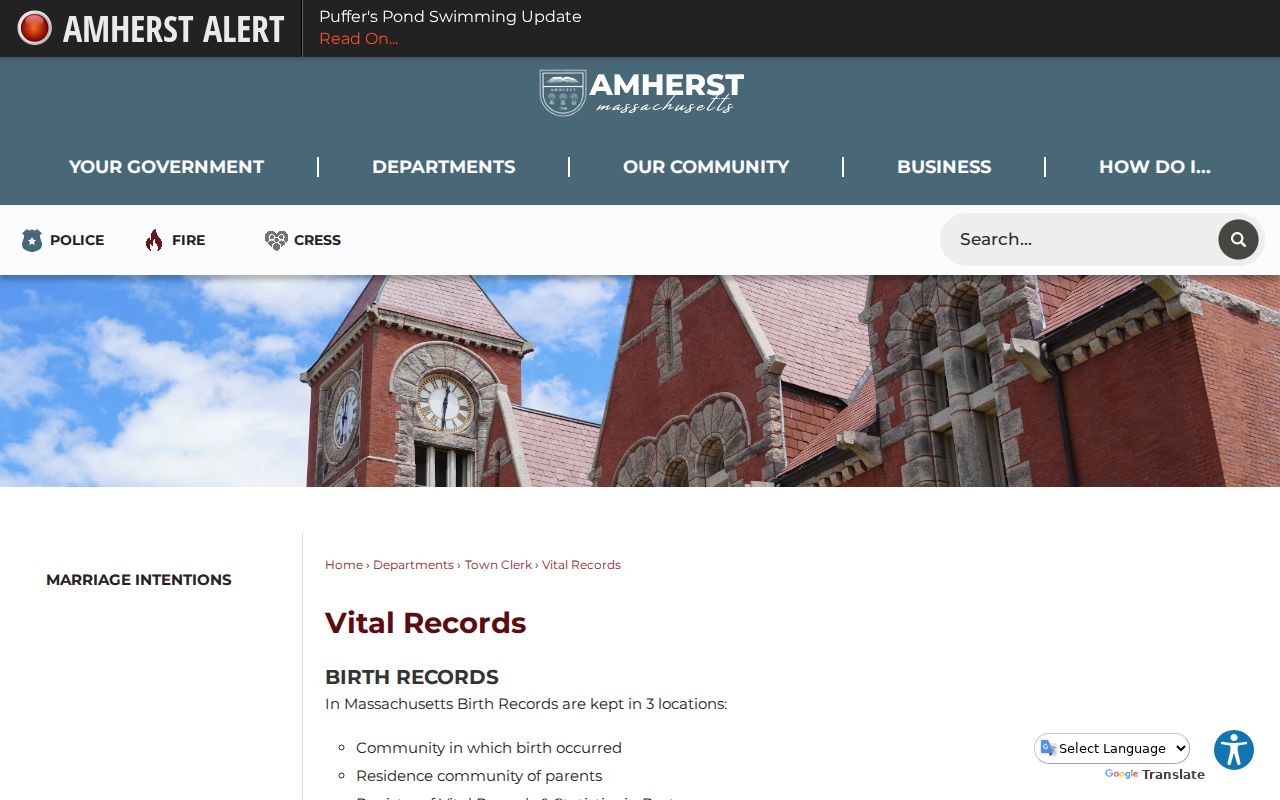
The local form asks for the event type, names, date, copies, requester contact, signature, payment, and return information. Use it for a properly routed request rather than assuming a town office holds every Massachusetts event.
Amherst Probate and License Checks
When a property changed after a death, an estate may explain a break in the deed chain. Hampshire Probate and Family Court in Northampton is the proper route for estate files and probate dockets serving Amherst. Search the name and case details, then obtain the physical public file or certified copy from the Register when appropriate. Heir, fiduciary, petition, will, estate-address, and transfer details should be compared to the parcel and later deed. Some family and probate material is impounded, so an unavailable result is not a reason to make an inference.
For a limited professional question, the Division of Occupational Licensure search accepts an individual or business selection, name, city, state, ZIP, board, license type, and license number. It can check public status and board context. It does not establish a home address or general location. Amherst DBA certificates and Secretary of the Commonwealth entity filings can likewise show a reported business connection or registered office, not a person’s residence.
Massachusetts license search shows the official individual and business lookup fields.
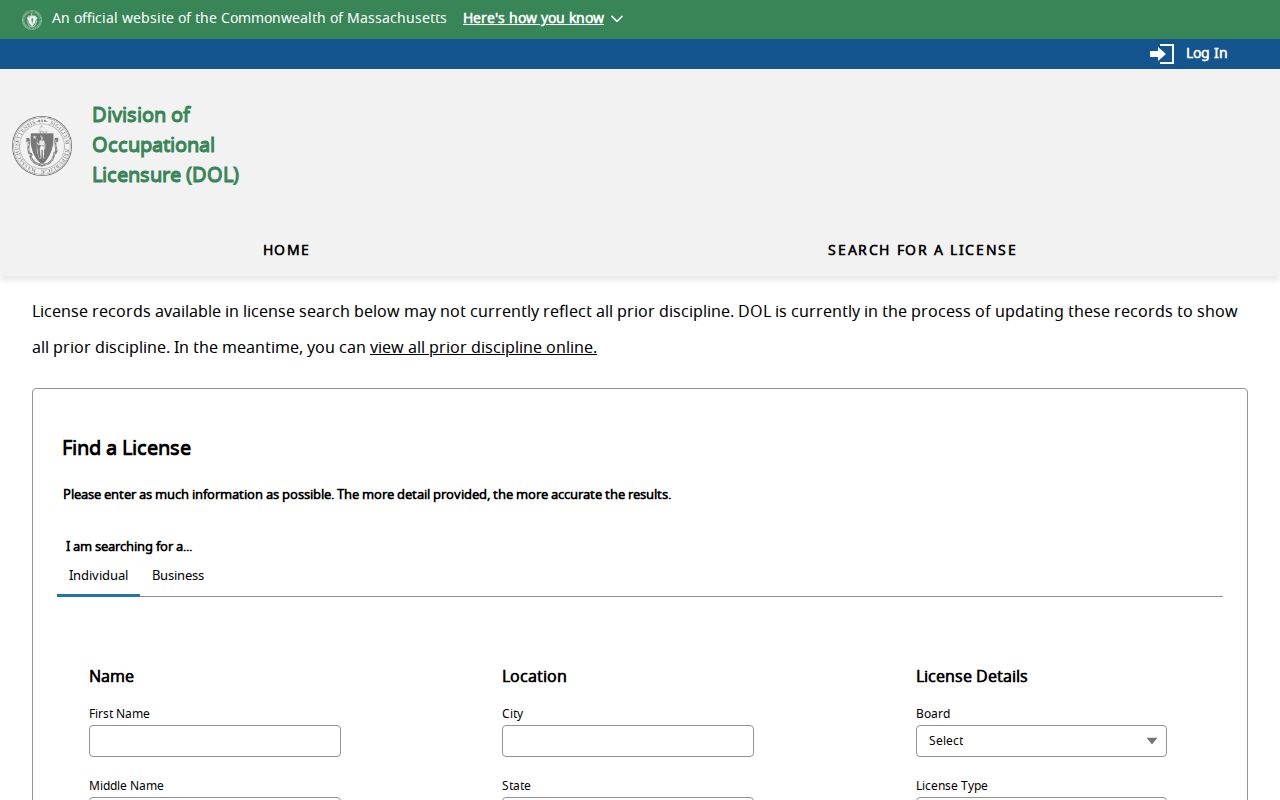
Use fewer fields if an exact license search returns nothing, then verify a result’s name, board, type, status, and date against the official detail record.
Amherst Resident Lookup Fallbacks
An online dead end often means the next channel is different, not that the record does not exist. MassCourts instructions allow a courthouse public terminal and a clerk file. The Registry can help with book, page, plan, and older unindexed land records. For a past household or a deceased person, Jones Library genealogy and local-history resources hold tax, newspaper, family, vital, census, map, manuscript, and clipping materials; the Amherst Historical Society and cemetery records can add date and place context. Historical evidence should still be labeled with its date rather than presented as current residence evidence.
For an administrative record that is public but not posted, make a narrow written request to the responsible records access officer under Massachusetts Public Records Law, M.G.L. c. 66, § 10. Identify the office, record type, time range, and preferred format. Written responses are generally due within 10 business days, subject to statutory rules and allowable production costs. A public-records request does not open sealed, impounded, juvenile, adoption, or other protected files.
Amherst Resident Privacy Limits
Massachusetts public-record access has firm privacy boundaries. Confidential voters may appear through a confidential voter number rather than a name and address. The Massachusetts Address Confidentiality Program provides a substitute-address and mail-forwarding option for qualifying people facing safety risks, and it does not make old disclosures disappear. Court records can be sealed, expunged, juvenile, adoption-related, or impounded. Restricted vital records, victim information, CORI, and motor-vehicle addresses are also outside an ordinary resident lookup.
The state SORI request procedure is a separate, narrow official process with online, mail, and police-station channels, identification, reason, and name or location requirements. It is not a general way to prove a person’s identity or location. For questions about a public protection record, follow the agency’s stated process and do not republish sensitive details.
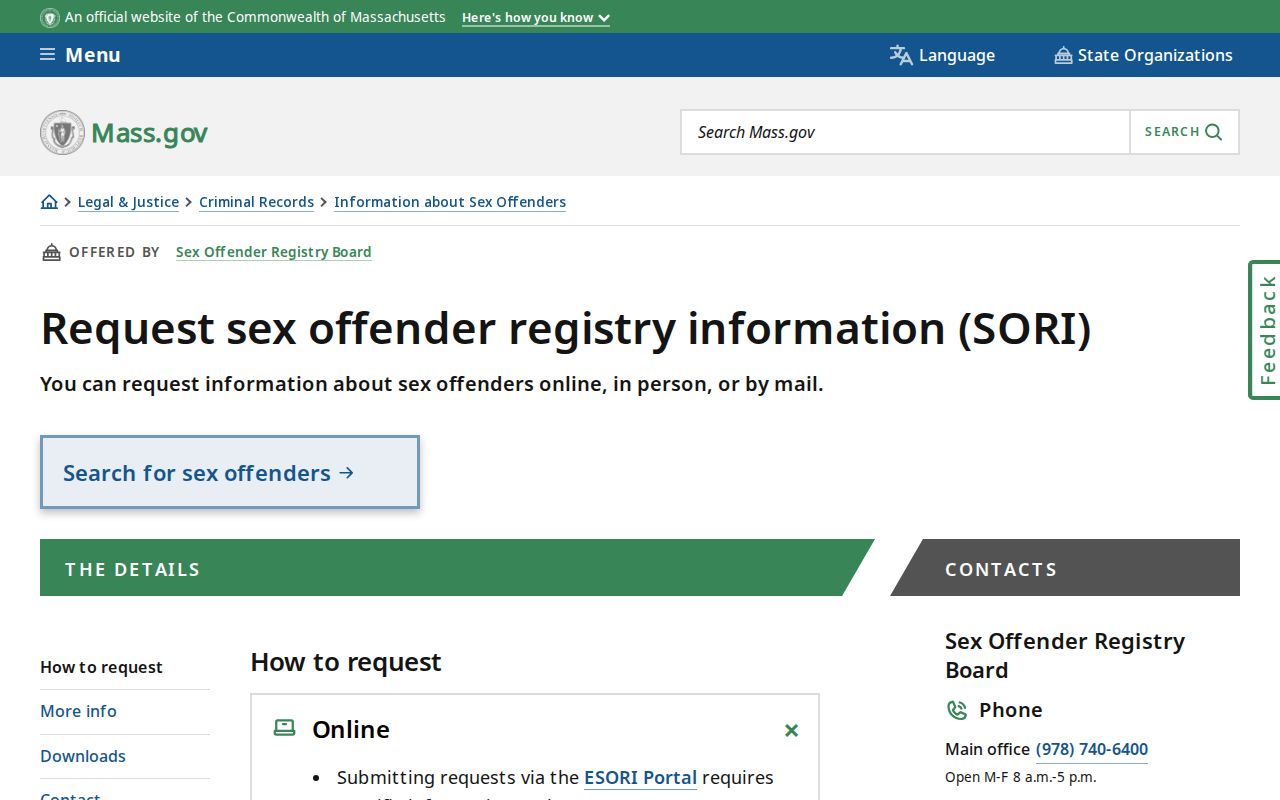
The request screen reflects an official process with limits, not a broad resident-search tool. A protected or missing record should remain protected.
Lawful use. Use Amherst resident lookup records only for lawful personal research. Never use a name, address, or record detail to stalk, harass, intimidate, or harm another person.